
IP Phones and VoIP in Kenya: A Complete Business Guide for 2026
Traditional desk phones connected to copper PSTN lines are becoming increasingly rare in Kenyan offices. In their place, IP phones — devices that route voice calls over a standard data network using internet protocols — have become the default choice for businesses of all sizes, from a five-seat SME in Industrial Area to a multi-branch enterprise spanning Nairobi, Mombasa, and Kisumu.
This guide explains what IP phones are, how VoIP technology works, which phone models are available in Kenya, and how to evaluate whether switching makes commercial sense for your business.
What Is an IP Phone?
An IP phone, also referred to as a VoIP phone, is a telephone that transmits voice calls over an IP (Internet Protocol) data network rather than a conventional analogue or digital telephone line. Physically, most IP phones resemble traditional desk phones. Internally, however, they function as small networked computers: they convert your voice into compressed digital data packets, transmit those packets across your LAN or the internet, and reassemble them at the receiving end in real time.
IP phones connect to your network via an Ethernet port on the back of the device. Most modern models also support PoE (Power over Ethernet), which means a single network cable simultaneously carries both data and electrical power to the phone — eliminating the need for a separate power adapter at each desk.
The signalling protocol used by the vast majority of IP phones sold in Kenya today is SIP (Session Initiation Protocol). SIP is an open standard, which means a SIP phone from Yealink will register to a Yeastar PBX, a 3CX server, or a Grandstream UCM just as readily as a proprietary phone would to its own brand’s system.
How VoIP Works: A Practical Overview
Understanding VoIP at a functional level helps when evaluating systems and troubleshooting connectivity issues.
When you dial a number on an IP phone, the following sequence occurs:
- Signalling — The phone sends a SIP INVITE message to the IP PBX (or directly to the remote device) to establish the call session.
- Codec negotiation — Both endpoints agree on a voice codec for the call. Common codecs in Kenya include G.711 (uncompressed, higher bandwidth, better quality) and G.729 (compressed, lower bandwidth, suitable for limited internet connections).
- Media transmission — Voice is transmitted as RTP (Real-time Transport Protocol) packets across the network throughout the call duration.
- Session termination — When either party hangs up, a SIP BYE message closes the session.
For calls that leave the office network and connect to the PSTN (Public Switched Telephone Network) — such as calls to Safaricom mobile numbers or international destinations — the IP PBX routes the call through either a GSM gateway (using a SIM card) or a SIP trunk (a VoIP channel from a licensed carrier). SIP trunking is increasingly the preferred option in Nairobi and other urban centres where fibre broadband is widely available.
IP Phone vs Traditional Analogue Phone: Key Differences
| Feature | Analogue Phone | IP Phone |
|---|---|---|
| Connection type | Dedicated copper pair to PABX | Ethernet / PoE via LAN switch |
| Cabling requirement | Separate voice cabling to each desk | Shares existing data network |
| Power source | PABX line voltage or adapter | PoE from switch or adapter |
| Voice quality | Standard (narrowband) | HD Voice (wideband) on supported codecs |
| Remote use | Not possible without hardware | Registers over internet from any location |
| CRM integration | Not supported | Supported via CTI middleware |
| Call encryption | None | TLS/SRTP supported |
| Scalability | Hardware expansion card required | Software licence + network port |
Types of IP Phones Available in Kenya
Entry-Level IP Phones
Entry-level SIP phones are designed for staff whose primary role does not involve high call volumes — reception areas, general admin desks, or back-office roles. They typically support 2 SIP accounts, a monochrome LCD display, dual 10/100 Mbps Ethernet ports, and PoE.
Representative models available in Kenya include the Yealink SIP-T21P E2, which features a 132×64 pixel graphical LCD, HD Voice, and support for IPv6, OpenVPN, and SRTP/TLS encryption. Similarly, the Fanvil X3SG offers Gigabit Ethernet at an entry price point, which is increasingly relevant as Gigabit LAN infrastructure becomes standard in Kenyan office builds.
Price range: approximately KES 8,500 – KES 14,000 per unit.
Mid-Range IP Phones
Mid-range phones target sales teams, customer service agents, and managers who require multiple line keys, a colour display, and more programmable buttons for speed dials, BLF (Busy Lamp Field) monitoring, and call park/pickup operations.
The Yealink T33G and Fanvil X5U are commonly deployed at this tier in Kenyan offices. Key differentiators at this level include colour TFT displays, support for 4–6 SIP accounts, Gigabit Ethernet, EHS (Electronic Hookswitch) for wireless headset integration, and built-in USB ports for call recording or Bluetooth dongle attachment.
Price range: approximately KES 14,000 – KES 28,000 per unit.
Executive / High-End IP Phones
Executive phones are deployed for senior management, reception consoles, and contact centre supervisors. They typically feature large colour touchscreen displays, built-in Bluetooth for mobile phone pairing, integrated Wi-Fi, multiple expansion module support, and up to 16 SIP accounts.
The Yealink T57W and Fanvil X7C represent this category. The T57W includes a 7-inch capacitive touch display, built-in Bluetooth 4.2, dual-band Wi-Fi (2.4 GHz and 5 GHz), and USB recording capability. These features make it suitable for executives who move between desk and meeting room while maintaining call continuity.
Price range: approximately KES 32,000 – KES 65,000 per unit.
Wireless IP Phones (DECT)
DECT (Digital Enhanced Cordless Telecommunications) phones operate on the 1.9 GHz frequency band, giving them immunity from Wi-Fi interference — a meaningful advantage in dense office environments. They are particularly well-suited to hotels, warehouses, hospitals, and retail environments in Kenya where staff move continuously across a site.
DECT deployments use a base station connected to the IP PBX, with multiple handsets roaming across the coverage area. Systems such as the Yealink W60B base station support up to 8 simultaneous calls and 8 registered handsets, while enterprise-grade systems like the Yealink W90 DECT Manager scale to hundreds of handsets across large campuses.
Video IP Phones
Video phones incorporate front-facing cameras and video codecs to support face-to-face calls over the IP network. The Yealink VP59 and Fanvil X210 are among the models available in the Kenyan market. These are typically deployed in boardrooms, executive offices, and receptions where video interaction with remote clients or branch offices is required.
Softphones
A softphone is a software application — installed on a laptop, desktop, or smartphone — that functions as a fully capable IP phone extension. No desk hardware is required. Staff working remotely from Karen, travelling to Eldoret, or working from a client site in Mombasa retain their office extension, can transfer calls, and appear on the company’s BLF panel as if they were at their desk.
Popular softphone applications include Zoiper, MicroSIP, 3CX WebClient, and Yealink VC Desktop. Most IP PBX platforms deployed in Kenya — including Yeastar, Grandstream UCM, and 3CX — include a softphone client as part of the base licence.
IP Phone Brands Commonly Available in Kenya
Yealink
Yealink is among the most widely stocked IP phone brands in the Kenyan market. The company manufactures a full range from entry-level SIP phones through to video endpoints and DECT systems. Yealink devices are compatible with all major SIP PBX platforms and are particularly well-regarded for their auto-provisioning capability, which simplifies large deployments.
Fanvil
Fanvil produces SIP phones at competitive price points relative to their feature sets, making them a popular choice for cost-sensitive deployments in Kenya. The brand covers standard desk phones, hotel room phones (designed for hospitality environments), intercom door phones, and nurse call endpoints.
Grandstream
Grandstream manufactures both IP phones and IP PBX systems, which means their phones and UCM PBX platforms have deep native integration. The Grandstream GXP series covers entry through executive tiers, while the GXV series adds Android-based video phone capability.
Cisco
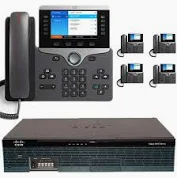
Cisco IP phones are deployed primarily in enterprise and financial sector environments in Kenya, where network security, platform integration with Cisco Unified Communications Manager (CUCM), and long hardware lifecycle are the primary requirements. Cisco hardware carries a premium over the brands above.
Snom
Snom is a German manufacturer with a strong focus on audio quality, security, and compliance for European and international deployments. Snom phones support SRTP and TLS encryption natively and are compatible with a wide range of SIP PBX platforms.
SIP Trunking in Kenya: Replacing Traditional Phone Lines
A SIP trunk is a virtual telephone line delivered over an internet connection. Instead of paying Safaricom or Airtel for a fixed number of analogue or ISDN lines, a business subscribes to a SIP trunk provider for a defined number of concurrent call channels.
The commercial logic is straightforward:
- A traditional Safaricom business line in Kenya costs a fixed monthly fee regardless of usage.
- A SIP trunk charges per channel (concurrent call capacity) and often per minute for outbound calls, with rates for international destinations substantially lower than PSTN equivalents.
- Inbound calls to a geographic or toll-free number are typically free of per-minute charges.
One SIP trunk with 8 channels can handle up to 8 concurrent calls, and by subscribing to a 16-channel SIP trunk, a company can manage up to 16 simultaneous calls. This makes SIP trunking particularly relevant for call centres, sales departments, and any organisation with high inbound call volumes.
The transport and signalling protocols for SIP trunking in Kenya follow the international standard: SIP over UDP, TCP, or TLS for signalling, and RTP or SRTP for media. Licensed SIP trunk providers in Kenya are regulated by the Communications Authority of Kenya (CA).
Key Features to Look for When Buying IP Phones in Kenya
When evaluating IP phones for a Kenyan business environment, the following specifications are worth examining carefully:
HD Voice / Wideband Audio
Look for phones that support wideband codecs (G.722 or Opus). Wideband audio captures voice frequencies up to 7 kHz compared to narrowband’s 3.4 kHz ceiling, resulting in noticeably clearer call quality — particularly useful when calling over Safaricom or Airtel mobile networks where background noise is common.
Gigabit Ethernet
Dual Gigabit Ethernet ports (one for the LAN, one for a passthrough to a connected computer) are important for offices that have deployed Gigabit infrastructure. Entry-level phones often ship with 10/100 Mbps ports, which are adequate for voice but create a bottleneck for any computer connected via the phone’s passthrough port.
PoE Support
PoE (IEEE 802.3af or 802.3at) eliminates the need for individual power adapters at each desk. Confirm that your LAN switch has sufficient PoE budget before deploying a large number of PoE phones — a standard 24-port PoE switch typically provides 370W total, sufficient for approximately 20–24 phones drawing standard PoE loads.
Security Protocols
For businesses in financial services, legal, or healthcare sectors, encryption is non-negotiable. Look for phones that support TLS (Transport Layer Security) for SIP signalling and SRTP (Secure Real-time Transport Protocol) for media encryption. Most mid-range and above phones from Yealink, Fanvil, Snom, and Cisco support both.
Auto-Provisioning
For deployments of 10 or more phones, auto-provisioning via a provisioning server URL or DHCP option 66 dramatically reduces deployment time. The phone downloads its configuration automatically on first boot rather than requiring manual programming at each handset.
Headset Compatibility
If staff are expected to use headsets — particularly in customer service or call centre roles — confirm that the phone supports EHS (Electronic Hookswitch) for the headset brand in use. EHS allows the headset to answer and end calls without touching the phone, which is important for desk-based agents.
Common VoIP Challenges in Kenya and How to Address Them
Internet Connectivity Reliability
VoIP call quality is directly dependent on network quality. Packet loss above 1–2% produces audible deterioration; jitter above 30ms causes choppy audio; latency above 150ms results in conversation overlap. For businesses relying on VoIP as their primary communication infrastructure, a secondary broadband connection (fibre primary, 4G LTE backup) with automatic failover is a prudent investment.
QoS Configuration
In offices where VoIP phones share a network with data traffic, QoS (Quality of Service) policies on the LAN switch and router must prioritise voice packets. Without QoS, a large file transfer or video stream can degrade simultaneous voice calls. Most managed switches from Cisco, MikroTik, Ubiquiti, and D-Link support DSCP-based QoS, which tags voice packets for priority forwarding.
GSM vs SIP Trunk Decision
Many smaller businesses in Kenya still use GSM gateways (devices that insert a Safaricom or Airtel SIM card into the PBX to route calls over the mobile network) rather than SIP trunks. GSM gateways have a lower monthly cost and work independently of internet quality, making them appropriate for locations with unreliable broadband. SIP trunks offer better scalability and lower per-minute rates for international calls, but require a stable internet connection to perform reliably.
Who Should Switch to IP Phones in Kenya?
The following business profiles derive the most direct benefit from an IP phone migration:
- Growing SMEs (10–50 staff): The ability to add extensions without additional cabling or hardware expansion cards makes IP systems significantly more scalable than traditional PABX.
- Businesses with remote or hybrid workers: Softphone clients and remote SIP registration allow home-based staff to use their office extension over any internet connection.
- Organisations with multiple branches: A unified IP PBX or cloud PBX links offices in Nairobi, Mombasa, Kisumu, or Eldoret on a single dial plan, with inter-branch calls routing over the data network at zero additional cost.
- Call centres and BPOs: SIP trunking, ACD (Automatic Call Distribution), IVR, and CRM integration are native capabilities of IP PBX platforms, whereas traditional PABX systems require expensive additional modules.
- Hotels and hospitality businesses: Fanvil and Grandstream manufacture IP phones specifically designed for hospitality — with wake-up call support, room-to-room dialling, and integration with property management systems.
- Healthcare facilities: DECT wireless IP phones allow clinical staff to remain reachable across wards and corridors without relying on cellular coverage inside buildings.
Summary
IP phones and VoIP technology have become the standard for business communication infrastructure in Kenya. The combination of lower call costs, HD voice quality, flexible remote registration, CRM integration capability, and scalability without additional cabling makes IP telephony a practical choice for organisations of almost any size.
Key points to carry forward:
- SIP is the universal standard — any SIP phone is compatible with any SIP PBX.
- PoE simplifies deployment — one cable per phone, no power adapters.
- Network quality determines call quality — invest in QoS configuration and a backup internet connection.
- GSM gateways remain relevant in locations with unreliable broadband; SIP trunking is preferred where fibre is available.
- Softphones extend the IP phone system to laptops and smartphones at minimal additional cost.
- Brands widely available in Kenya include Yealink, Fanvil, Grandstream, Cisco, and Snom — each with different price-to-feature profiles suited to different deployment types.

 No products in the cart.