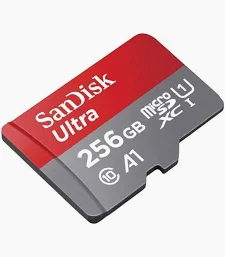
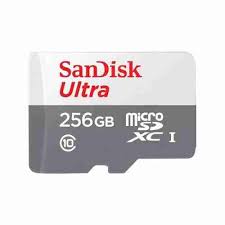
SanDisk Ultra microSDXC UHS-I 256GB – 150MB/s
SanDisk Ultra microSD 150MBs 256GB marks a step up within the Ultra lineup — not only in capacity, but also in speed. Where the 64GB and 128GB Ultra cards top out at 140MB/s, the SDSQUAC-256G reaches a higher sequential read ceiling of 150MB/s, a 7% increase driven by SanDisk’s proprietary controller technology. Paired with 256GB of microSDXC storage, A1 application performance, and five-point environmental protection, this card targets Android power users, Chromebook users with demanding offline storage requirements, and compact camera shooters who have outgrown smaller capacities.
At 256GB, the SDSQUAC-256G moves beyond everyday top-up storage and into primary device storage territory — large enough to carry an entire media library, extended video recordings, and a full app data set on a single card.
Read Speed and UHS-I Interface
The SanDisk Ultra 256GB operates on the UHS-I (Ultra High Speed Phase I) bus, which defines a standard ceiling of 104MB/s. SanDisk’s proprietary controller pushes the SDSQUAC-256G to sequential read speeds of up to 150MB/s — provided the host device and card reader both support UHS-I. Devices operating on a slower interface cap the card at their own throughput limit instead.
In real-world transfer scenarios, that speed moves approximately 1,000 photos per minute through a USB 3.0 card reader, based on SanDisk’s internal testing using images averaging 3.55MB. As with all flash storage, write speeds trail read speeds — the card’s Class 10 and U1 ratings establish the minimum write speed floor rather than the maximum.
Notably, the 150MB/s read speed on the SDSQUAC-256G represents SanDisk’s current ceiling for the Ultra range at 256GB and above. Cards in the 64GB–128GB Ultra tier (SDSQUAB) reach 140MB/s, while the 32GB Ultra (SDSQUA4) reaches 120MB/s. Buyers comparing capacities within the Ultra lineup should factor in this speed differentiation alongside storage size.
Speed Class Ratings Explained
The SanDisk Ultra 256GB carries three speed class designations, each addressing a distinct performance requirement:
- Class 10 (C10): Sets a minimum sustained write speed of 10MB/s under the legacy SD speed class standard. This floor meets the baseline requirement for continuous Full HD (1080p) video recording at 1920×1080 resolution.
- UHS Speed Class 1 (U1): The UHS-I counterpart to Class 10, guaranteeing the same 10MB/s minimum write speed on UHS-I enabled host devices. U1 actively supports real-time Full HD video recording. That said, users shooting 4K should move to a V30-rated card instead — 4K recording demands a minimum 30MB/s sustained write speed that the SanDisk Ultra does not provide.
- Application Performance Class A1: Guarantees a minimum of 1,500 random read IOPS and 500 random write IOPS. Rather than improving sequential transfers, this rating directly benefits Android users who store apps or app data on the card. A1 performance reduces app launch latency and accelerates loading of in-app assets — graphics, audio files, saved profiles, and permissions data — all of which rely on random I/O rather than sequential throughput.
Storage Capacity: What 256GB Holds
At 256GB, the SDSQUAC-256G shifts the use case from supplementary overflow storage to a card capable of serving as the primary media repository on a device. In practical terms, 256GB accommodates:
- Approximately 8,000+ photos at 24MP resolution (JPEG)
- Extended hours of Full HD 1080p video — enough for multi-day trips, events, or continuous dashcam recordings across several weeks of loop recording
- Full offline content libraries on Android and Chromebook devices, including downloaded Netflix, YouTube, and Spotify content alongside documents and working files
- Large app data sets, cached game assets, and WhatsApp media accumulated over months of active use
- A mixed professional workload combining RAW image bursts from a compact camera, audio recordings, and project documents
Beyond the card itself, the included full-size SD adapter extends the SDSQUAC-256G to DSLR cameras, mirrorless cameras, Windows laptops with SD card slots, and desktop card readers.
New Model Prefix: SDSQUAC vs SDSQUAB
Buyers familiar with the SanDisk Ultra 64GB and 128GB (both using the SDSQUAB prefix) will notice the 256GB adopts a new prefix — SDSQUAC. This prefix change across the Ultra lineup reflects the speed tier differentiation: SDSQUAC cards (256GB and 512GB) reach 150MB/s, while SDSQUAB cards (64GB and 128GB) top out at 140MB/s. The physical format, interface, speed class ratings, and durability specifications remain consistent across both families. In summary:
- SDSQUA4 – 32GB – up to 120MB/s
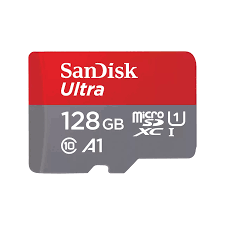
- SDSQUAB – 64GB, 128GB – up to 140MB/s
- SDSQUAC – 256GB, 512GB, 1TB – up to 150MB/s
App Performance and SanDisk Memory Zone
The A1 rating on the SanDisk Ultra 256GB actively supports Android devices running version 6.0 and above that use adoptable storage, formatting the card as part of the device’s internal storage pool. Rather than functioning as slow overflow storage, the SDSQUAC-256G participates in app performance through its 1,500 read IOPS floor — reducing latency for app launches and in-app asset loading.
Beyond adoptable storage, the card works with the SanDisk Memory Zone app (available on Google Play), giving users a centralised interface to:
- View and manage files across both internal and external storage
- Automatically route media files, downloads, and WhatsApp content to the microSD card
- Back up card content to linked cloud storage services
Together, A1 performance and Memory Zone support make the SDSQUAC-256G a structured long-term storage management solution for Android users with large, growing media libraries.
Durability and Environmental Protection
To protect stored data across demanding environments, the SanDisk Ultra 256GB passes standardised testing against five environmental stress factors:
- Waterproof – Survives water exposure without data loss
- Temperature proof – Operates across -25°C to 85°C, with a non-operating storage range of -40°C to 85°C. This tolerance covers Kenya’s climate range — from hot low-altitude coastal and inland areas to cooler highland environments — as well as in-car dashcam conditions where cabin temperatures rise sharply under direct equatorial sun
- Shockproof – Withstands drops and physical impact without data loss
- X-ray proof – Passes through airport security X-ray scanners without data corruption
- Magnet proof – Flash memory architecture means magnetic fields leave stored data unaffected
These ratings apply to the SDSQUAC-256G card itself. The included SD adapter does not carry an independent durability certification.
Chromebook and Windows Laptop Compatibility
Beyond smartphones and tablets, the SDSQUAC-256G explicitly supports Chromebooks and Windows laptops with microSD or SD card slots (the latter via the bundled adapter). SanDisk also produces a Chromebook-specific variant of this card (SDSQUAC-256G-GN6FA), underscoring the device category’s relevance at 256GB.
For Chromebook users, 256GB provides enough capacity to run a complete offline workflow — downloaded Google Drive project folders, Android apps from the Play Store, offline Spotify libraries, and locally cached video content — on devices that frequently ship with 32GB or 64GB of eMMC onboard storage. For Windows laptop users, the included SD adapter turns the SDSQUAC-256G into a practical portable storage drive without additional hardware.
Who Is This Card Best Suited For?
- Android users who use their phone as their primary camera and media device – At 256GB, the SDSQUAC-256G holds 8,000+ photos at 24MP, weeks of video, and months of accumulated app data simultaneously. Furthermore, the A1 rating (1,500 read IOPS / 500 write IOPS) ensures that high-capacity storage doesn’t come at the cost of app loading speed.
- Compact camera and mirrorless camera shooters – The 256GB capacity accommodates extended RAW and JPEG shooting sessions without card swaps. The included SD adapter enables direct use in full-size SD slots on most mirrorless cameras and DSLRs. However, shooters requiring 4K video recording should move to a V30-rated card — the SDSQUAC-256G’s U1 rating supports Full HD only.
- Chromebook users replacing limited onboard storage – 256GB effectively transforms a constrained Chromebook into a device with substantial local storage. SanDisk explicitly certifies this card for Chromebook use, covering offline Drive files, Play Store apps, and downloaded media libraries.
- Dashcam users running extended or multi-camera setups – The wide operating temperature range (-25°C to 85°C), sustained write capability, and 256GB capacity combine to extend loop recording duration significantly before overwrite cycles begin. This is particularly relevant for commercial vehicles or long-haul drivers in Kenya who require multi-day footage retention.
- Travellers carrying a single-card setup – 256GB eliminates the need to manage multiple cards on extended trips. The five-point durability profile — water, shock, temperature, X-ray, and magnet protection — covers both transit risks and destination conditions across Kenya’s varied environments.
- Buyers stepping up from 128GB – Users who regularly fill 128GB within weeks will find 256GB the natural next step within the Ultra range. Additionally, the SDSQUAC-256G delivers a speed increase to 150MB/s over the 140MB/s ceiling of the 128GB Ultra — a secondary benefit on top of the capacity gain.
Reviews
There are no reviews yet.